Article 11 of 13
MIT Engineers Create Paper-Thin Bio-Hybrid Robot Driven by Living Tissue
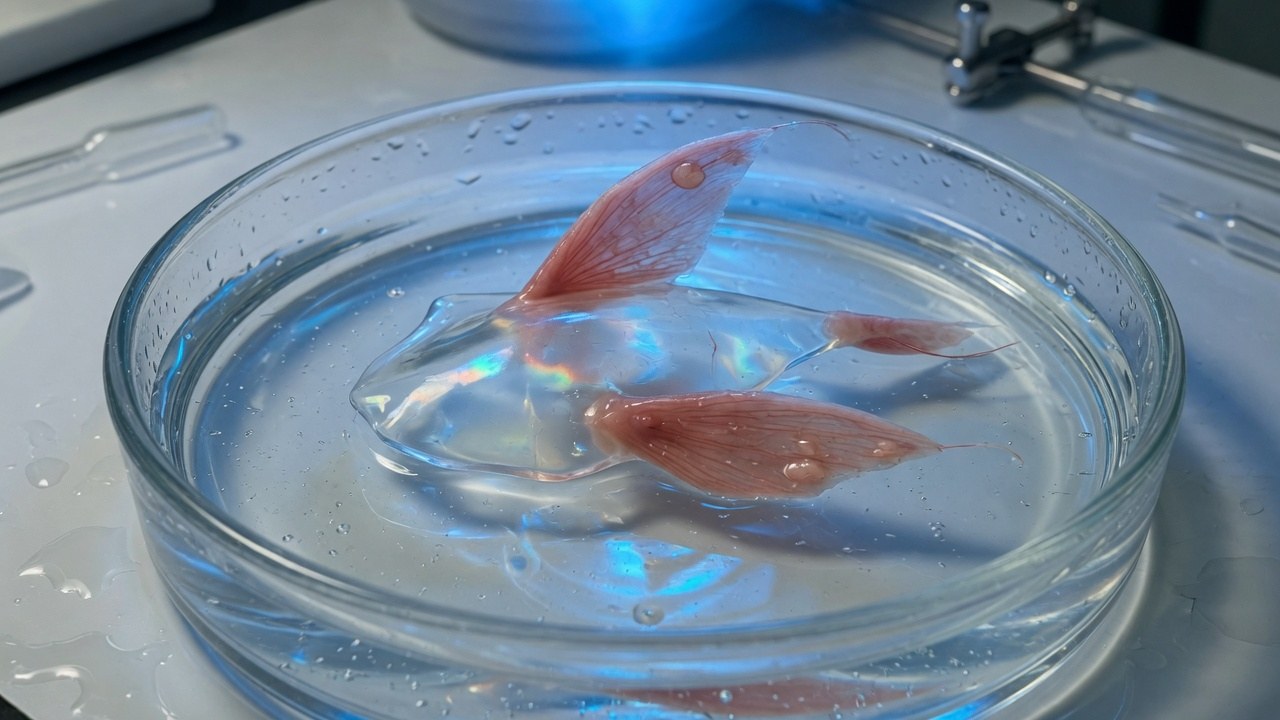
Bio-Hybrid Robotics: Light-Controlled Swimming Robots Powered by Living Muscle Cells
Summary
Engineers at the Massachusetts Institute of Technology (MIT) have engineered a paper-thin, bio-hybrid robot capable of swimming through fluid environments using actual living skeletal muscle cells. By patterning genetically modified muscle tissue onto flexible hydrogel skeletons, researchers can actuate and steer the micro-swimmer using targeted flashes of light.
Deep Dive: Merging Biology with Mechanical Systems
Traditional aquatic robotics rely on rigid electric motors, electromagnetic actuators, or chemical propellants that require bulky battery packs. Bio-hybrid robotics takes a radically different approach: leveraging biological muscle tissue, which offers unmatched energy efficiency and force-to-weight performance at microscopic scales.
The team, led by MIT Associate Professor of Mechanical Engineering Ritu Raman, resolved critical design challenges in micro-fabrication and cell alignment:
- Micro-patterned Skeleton: The robot utilizes a thin substrate made of gelatin methacrylate (GelMA) hydrogel. Microscopic grooves molded into the gel surface guide the living skeletal muscle cells to grow in precise alignment, producing synchronized, high-force contraction vectors.
- Optogenetic Control: The muscle cells are genetically engineered to contract in response to blue light pulses.
- Dual-Muscle Steering: Designed with two independent fin actuators, the swimmer can execute linear motion when both fins flap in unison, or initiate turn maneuvers when light selectively stimulates a single side.
Key Takeaways for Industry & Scientific Research
- Targeted Environmental Sensing: Bio-hybrid micro-swimmers can navigate sensitive or confined aquatic environments without releasing toxic electronic runoff or mechanical debris, making them ideal candidates for water quality monitoring.
- Medical & Diagnostic Potential: Soft, cell-based micro-actuators pave the way toward biologically compatible systems capable of navigating microfluidic pathways, aiding in drug delivery research and biomedical testing.
- Self-Healing & Sustainability: Unlike synthetic metals or plastics, biological tissue inherently possesses self-repair mechanisms, laying the groundwork for long-duration biological machines that consume organic nutrients rather than stored grid power.
Read this as a research muscle, not a catalog part
Light, gel, and a pull you can aim
This swimmer is a lab device. The motor is living muscle on a soft strip. Blue light makes the engineered cells contract. Lighting one side, then the other, is how it steers. It is worth reading for the idea, not for a part number you can order and bolt down. At a very small size, muscle is interesting because the tissue can pull hard for its weight while nutrients around it act as fuel. A coil or a motor that tiny still needs wires and a battery, and those parts soon weigh more than the little machine that moves. Grooves molded into the gel tell the cells which way to line up, so the pull becomes a flap instead of a twitch in every direction. Light picks the flap. That is easier to aim than a wire running to every cell.
What the tissue will not survive
The limits belong beside the result. Living cells need a friendly fluid, a temperature they can stand, and sterile handling. They tire, they can be contaminated, and they do not sit through a dry shift on a factory floor. Tissue can repair some damage in a dish. That is not a gripper that stitches itself on a night shift. Water sensing and medical channels are directions for laboratories, where a soft swimmer might one day move through a passage a propeller would wreck. They are not a claim that the device is ready to leave the fluid it was grown in.
Match the actuator to the place
The habit worth copying is the match between the actuator and the place it has to work. Theirs was wet, tiny, and hard to reach with wires. Your station might use ordinary hardware and still face the same question. If the station is washed down, choose materials and seals that accept the wash. If the part is soft, choose a gripper that gives, instead of a harder squeeze. If a cable cannot follow the motion, put power on the moving piece and plan the maintenance that choice creates. The paper-thin swimmer is a reminder to pick the muscle for the job, even when the muscle you can buy is still an electric motor.
Suggested Website Tags
For a visual demonstration of how the optogenetic muscle tissue is controlled, watch this short clip on MIT's Light-Powered Muscle Robot. This clip shows the light-sensitive fins actuating and steering the bio-hybrid robot in a fluid dish.
Help setting up a robot cell: choose the hardware, lay out the cell in software, and membership support for $19.99 a month.