Article 10 of 13
On-Robot Intelligence Triggers Squeeze in High-Bandwidth Edge Computing and Memory Chips
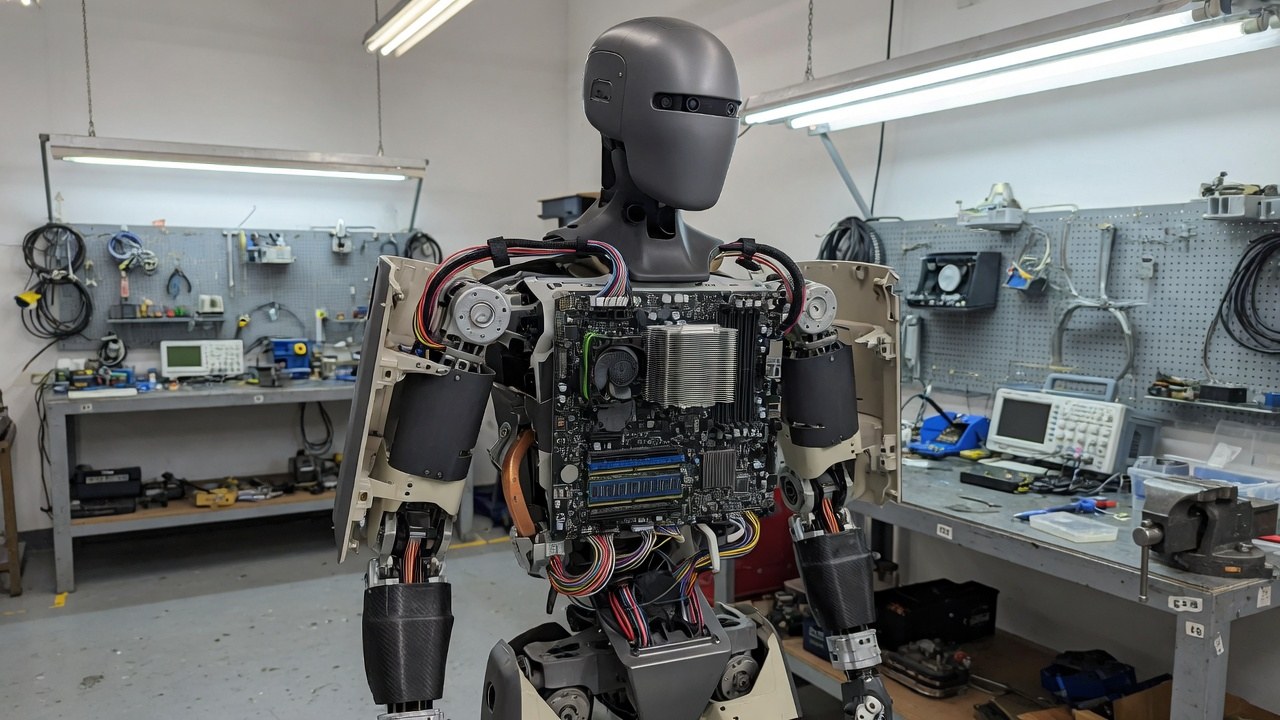
Humanoid Robots Drive New Demands for Memory and Edge Computing Hardware
Summary
As bipedal humanoids move from lab demonstrations to multi-site pilot programs, hardware requirements are undergoing a fundamental shift. Real-time execution of multimodal Vision-Language-Action (VLA) models on untethered mobile robots is driving high demand for onboard high-bandwidth memory (HBM), low-power LPDDR5/DDR5 systems, and high-density NVMe storage stacks.
Deep Dive: The Onboard Compute Challenge
Unlike warehouse Autonomous Mobile Robots (AMRs) or stationary industrial arms that rely on cloud offloading or external servers, bipedal humanoids require instantaneous, localized decision-making. A delay of even a few milliseconds in motor torque calculations can cause balance failure or unsafe collision.
Data Ingestion Stack (Per Second)
- Multi-Camera Stereo Video (60fps) + Tactile Sensor Grids + High-Rate IMU Arrays
- Onboard Edge GPU / NPU Processing (Real-Time Inference)
- High-Frequency Actuator Torque Commands (1,000Hz Loop)
Key Bottlenecks Shaping Next-Gen Hardware
- Memory Bandwidth Over Pure FLOPS: Running quantized 7B to 13B parameter VLA models directly on a robot's torso-mounted compute stack requires extreme memory bandwidth to stream weights into tensor cores without thermal throttling.
- Thermal & Power Budgets: Humanoid battery life currently averages 2 to 4 hours under typical workloads. Compute modules must operate within tight 15W–60W thermal envelopes to avoid shortening shift runtimes or adding heavy liquid-cooling loops.
- High-Vibration Solid-State Storage: High-density PCIe 4.0/5.0 NVMe drives are being ruggedized to sustain continuous high-write speeds—recording multi-camera sensor logs and local spatial maps without failing under structural vibration.
Key Takeaways for Hardware & Semiconductor Investors
- Spike in Memory Demand: Market projections show mobile robotics becoming a major growth driver for DRAM, high-density LPDDR5, and embedded edge storage over the next decade.
- Actuator vs. Compute Bill of Materials (BOM): While high-torque actuators and harmonic drive gearboxes still account for 40–60% of total humanoid manufacturing costs, sensor and edge computing hardware now represent up to 20% of total BOM.
- Emergence of Robotics System-on-Chips (SoCs): Semiconductor manufacturers are designing dedicated robotics SoCs that integrate CPU cores, neural processing units (NPUs), real-time CAN/EtherCAT controllers, and camera ingest engines onto single silicon dies.
Put the computer where a delay is dangerous
A walker cannot pause the way an arm can
The point of the onboard computer is timing. A walking machine has to choose a step before it falls. A delay that a stationary arm hides inside a short pause will tip a humanoid. The computer rides in the body, near the motors, and the memory has to feed it fast enough that the motion loop does not stall. A packing arm can ask a small PC on a shelf whether a label is good and wait a fraction of a second. A walker cannot wait that long to decide where a foot goes. That is why memory speed, a tight power budget, and storage that survives shaking show up in the same conversation. The model weights have to stream into the chip. The chip has to stay cool enough for the battery and the shell. The drive that records cameras and maps has to keep writing while the frame vibrates.
The same rule on a normal cell
If you are not buying a humanoid, keep the lesson about where the decision lives. Put the stop and the safety check on a controller that does not depend on a distant server. Put the camera decision on a computer close enough that a dead network does not leave the arm committed to a move. Save enough video to explain a miss the next morning, on a drive that stays mounted in the cell. A laptop someone carries home is not a record. Label the computer the way you label the arm, so a fault has a box, a power supply, and a person who is allowed to swap it.
Three questions for a walking pilot
If you do evaluate a humanoid, ask how long it works while doing your task, not while standing for a video. Ask what happens to balance if the large model is late by a few cycles. Ask which computer, battery, and cooling come out of the machine when they fail, and whether your technician can swap them without a factory visit. Shares of a bill of materials will change from year to year. Time, heat, and a way to replace the computer will not change. Write the answers next to the demo notes before you compare one machine with another.
Suggested Website Tags
Help setting up a robot cell: choose the hardware, lay out the cell in software, and membership support for $19.99 a month.