Article 9 of 13
Bridging the Sim-to-Real Gap: Why Synthetic Data Is Becoming the Primary Engine for Robot Training
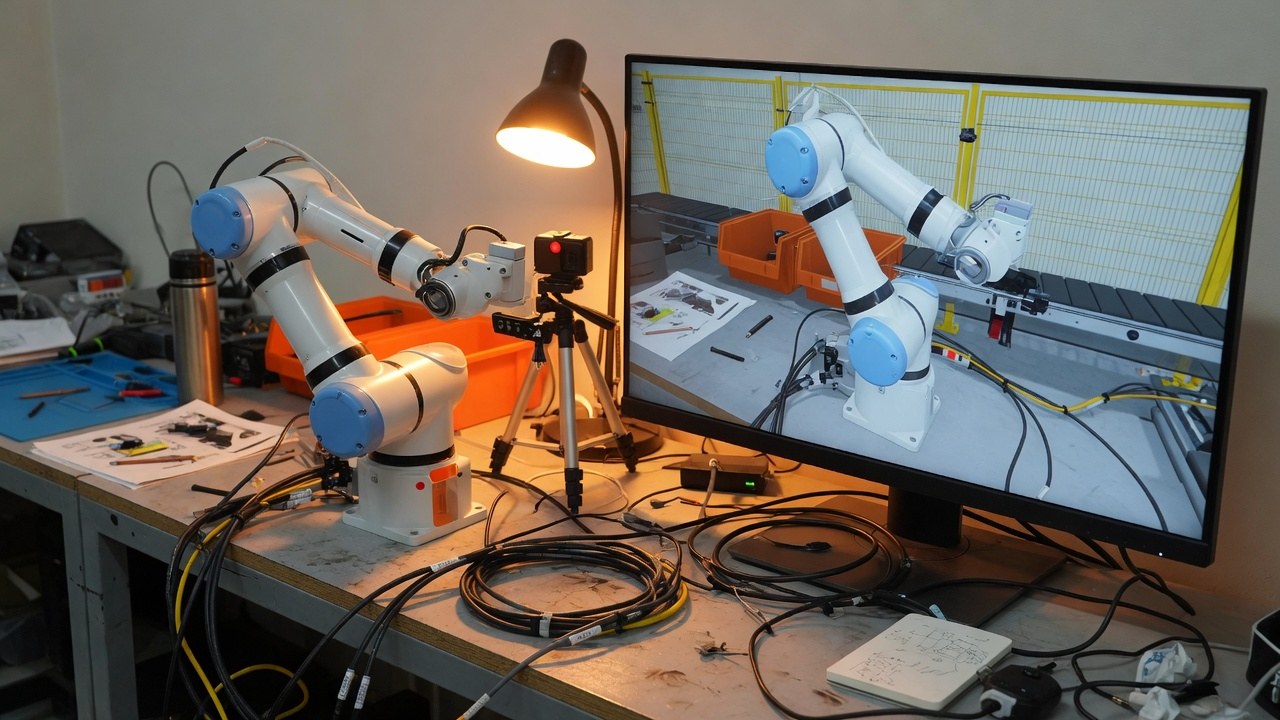
Robotic Data Infrastructure & Synthetic Data Policy Training
Summary
As physical teleoperation and human demonstration collection hit scale limitations, robotics developers are turning to physics-based synthetic data infrastructure. Advanced simulation frameworks like NVIDIA Isaac Sim and Isaac Lab allow teams to train robotic policies across millions of parallel virtual environments, achieving high zero-shot success rates when transferring models directly to physical hardware.
Deep Dive: Moving Beyond Physical Teleoperation
Collecting physical data using human operators wearing VR headsets or guiding motion-capture rigs is slow, expensive, and difficult to scale. To reach the millions of state transitions required to train robust foundation models, engineering teams are building "digital twin" training environments that generate synthetic sensor feeds automatically annotated with 3D ground truth.
Data Collection Bottleneck
Physical Teleoperation
- Slow (~100s of demos/day)
- High Hardware Wear
Synthetic Data Pipelines
- Scalable (Millions of frames/hour)
- Zero Hardware Wear
Key Innovations Closing the Reality Gap
- Domain Randomization: Simulators continuously mutate scene lighting, camera angles, object textures, surface friction, and mass distributions during training. This forces the neural network to focus on underlying structural geometry and physical affordances rather than memorizing superficial visual cues.
- Neural Rendering & Gaussian Splatting: By integrating 3D Gaussian Splatting and photorealistic ray tracing into simulation pipelines, sensor data generated in virtual space closely matches real-world camera noise, refractions, and reflections.
- Parallelized Physics Engines: GPU-accelerated physics engines execute thousands of articulated robot simulations simultaneously, reducing policy training times from weeks on real hardware to hours in simulation.
Key Takeaways for Industry & AI Engineers
- Hybrid Data Ratios: Leading AI robotics teams typically combine a large base of synthetic simulation data (up to 80–90%) with a small target dataset of real-world physical demonstrations (10–20%) to fine-tune final deployment performance.
- Safety & Edge Case Testing: Synthetic infrastructure enables developers to test dangerous or destructive scenarios—such as high-speed collision avoidance, liquid spills, or fragile item drops—without damaging expensive hardware.
- Shift in R&D Focus: The primary competitive advantage in robotics development is transitioning from mechanical hardware design toward data pipeline fidelity, simulation accuracy, and automated asset generation.
Use invented practice, then prove it on your line
The simulator already knows the answer
Synthetic data means pictures and physics a computer invented, with the correct answer already attached. In a real video, someone has to label every part. In a simulator, the part's position is known because the simulator placed it. That is why teams can create huge numbers of examples. The trap is a picture cleaner than your shop. A model can memorize the simulator's lighting and then miss under your lights, on your bags, and on your scuffed table. If the virtual camera never sees glare, the real camera's glare looks like a new object.
Mess up the practice on purpose
Domain randomization means changing the practice scene on purpose. Vary the light, the table color, the friction, and the camera angle while the robot repeats the job. The model has to hang on to the shape of the part and the way it moves, because the paint job never sits still. This is useful, and it is not a substitute for real cycles on your line. Those cycles show the cable that sags into the frame, the shine off a pouch, and the fixture that is a little off the drawing. No amount of random paint invents a cable you forgot to model.
Crash in the model, count misses in metal
Use the simulator for trials you do not want to run in metal. A fast move into a clamp, a drop of a fragile part, or a person stepping into the reach can be ugly in the model and then turned into a limit on the real arm. Use the real gripper, the real part, and the real light for the last count of misses. A mix that is mostly simulated practice plus a smaller set of real demonstrations only helps if that smaller set is your parts. A small shop often does not need a mountain of fake frames to begin. A drawing of the cell, a camera in a fixed place, and saved pictures of good and bad parts will teach you faster than a simulator will. Simulation earns its time when the variety is wide, a crash would be expensive, or the model must handle objects it has not held. Until then, a fixture and a simple check will tell you more per hour than a polished virtual factory.
Suggested Website Tags
Help setting up a robot cell: choose the hardware, lay out the cell in software, and membership support for $19.99 a month.