Article 6 of 13
Cobots Transform Pharmaceutical R&D and Clinical Diagnostics with High-Precision Automation
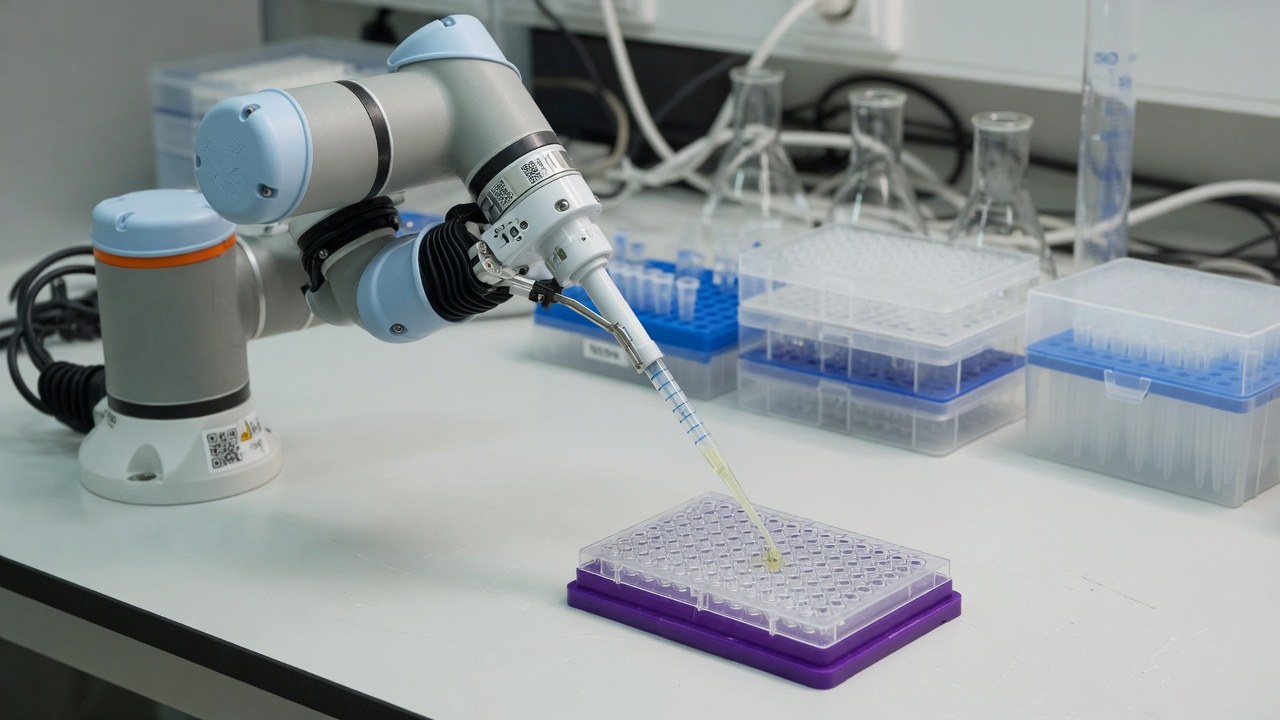
Collaborative Robots (Cobots) Extend Reach in Life Sciences & Lab Automation
Summary
Collaborative robots (cobots) are rapidly becoming standard equipment in life sciences, pharmaceutical laboratories, and medical diagnostic facilities. Designed with force-limiting safety sensors, compact footprints, and cleanroom-certified enclosures, these adaptive robotic assistants handle repetitive liquid handling, sample preparation, and high-throughput screening without requiring protective safety cages.
Deep Dive: Accelerating Scientific Discovery
In modern clinical labs and biopharma facilities, precision and traceability are paramount. Manual liquid handling and sample transfers are not only prone to human error and cross-contamination, but they also contribute to repetitive strain injuries (RSI) among laboratory technicians.
Cobots solve these operational hurdles by working directly alongside human researchers:
Traditional Automated Workcells
- Heavy Caging
- Rigid Fixturing
- Fixed Single-Task Automation
- High Setup Cost
Cobot Lab Automation
- Zero Caging
- Human-Side Operation
- Flexible Re-tasking via Vision
- Rapid ROI
Primary Application Areas Driving Growth
- High-Throughput Assays & Pipetting: Cobot arms fitted with multi-channel micro-pipettes dispense micro-liter fluid volumes with consistent accuracy across thousands of well-plates.
- Biobank Sample Management: Vision-guided cobots identify barcode labels, uncap cryo-vials, and manage liquid nitrogen storage racks in sterile environments.
- Automated Centrifuging & Incubation: Cobots handle transfer tasks between centrifuges, plate washers, thermal cyclers, and optical readers, maintaining continuous 24/7 testing workflows.
Key Takeaways for Healthcare & Biotech Executives
- Simplified No-Code Interfaces: Modern lab cobots utilize drag-and-drop graphic interfaces and hand-guided teach modes, enabling lab technicians and molecular biologists to reconfigure workflows without writing code.
- Cleanroom & Chemical Compatibility: Specialized ISO Class 5 cleanroom cobots feature smooth, sealed surfaces resistant to harsh chemical sterilizers like vaporized hydrogen peroxide (VHP).
- Maximizing Human Expertise: Automating tedious sample handling allows research scientists to spend less time on manual prep and more time analyzing data and designing clinical trials.
Put the arm on one handoff
The force limit is not the whole safety case
A cobot in a lab is an arm with a limit on force and sensors that notice a bump. Those features are why a person can share the bench. They do not remove the need for a risk check. A pipette tip, a spinning centrifuge, an open chemical, and a cold rack are hazards a force limit does not remove. You can leave the cage off only after you have named what the arm might hit, how a person stops it, and what happens if the stop is pressed mid-move. Write that down where the technician loads the work, not only in a binder.
Trace the sample before you buy the reach
Follow one sample on paper. Where the tube arrives, who labels it, which machine spins it, and where it sits when the test is done. Give the arm a handoff you can say in one sentence, such as moving a plate from a fixture to a reader. Leave the odd sample and the spilled well with the technician. That split is how scientists get time back for the data. Taught points need their assumptions written beside them. The plate is seated, the cap is off, the reader door is open. If one of those is wrong, the point you showed the arm by hand is a crash. A short checklist at the bench is part of the program.
Wipe-down and a line in the record
A smooth sealed arm is easier to wipe. It is not automatically fit for your chemical or your cold storage. Ask which cleaners the surface survives, whether the gripper can be changed without shedding debris, and how the arm records the plate it touched. A lab lives on knowing which sample went where. The robot should add a line to that record, with time and station, instead of becoming a gap. If the arm cannot tell you what it moved, it is not finished, however smooth the motion looks.
Suggested Website Tags
Help setting up a robot cell: choose the hardware, lay out the cell in software, and membership support for $19.99 a month.