Article 5 of 13
Spatial AI and 3D LiDAR Drive Widespread Transition from Fixed AGVs to Flexible Autonomous Mobile Robots
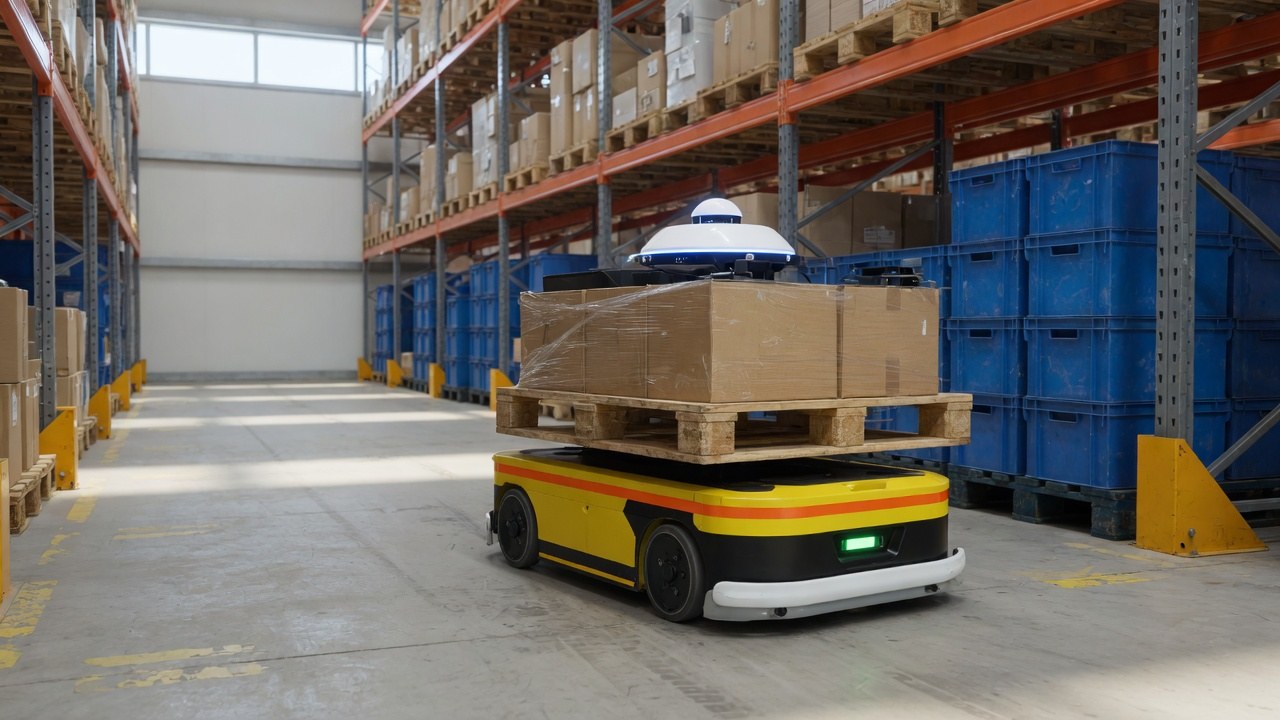
Autonomy on the Factory Floor: AMRs Rapidly Replace Legacy AGVs
Summary
The industrial logistics landscape is undergoing a decisive shift as facility operators replace legacy Automated Guided Vehicles (AGVs) with Autonomous Mobile Robots (AMRs). Powered by onboard 3D LiDAR, multi-camera spatial AI, and dynamic SLAM (Simultaneous Localization and Mapping) engines, modern AMRs operate without fixed magnetic tape, floor inductors, or optical reflectors—delivering unprecedented flexibility to smart factories and fulfillment centers.
Deep Dive: The Shift from Fixed Paths to Dynamic Navigation
For decades, AGVs provided reliable material transport across factory floors. However, their reliance on fixed physical tracks made layout changes expensive and disruptive. If a human or forklift blocked an AGV’s pre-programmed path, the vehicle had to stop and wait until the obstacle was manually cleared.
Next-generation AMRs eliminate these operational bottlenecks by calculating dynamic, real-time routes around obstacles.
Legacy AGV System
- Fixed Floor Markers
- Single-Track Route
- Full Stop on Obstacle Encounter
- Inflexible Layout
Modern AMR Fleet
- 3D Spatial LiDAR + Visual SLAM
- Dynamic Path Planning
- Real-Time Obstacle Avoidance
- Instant Layout Changes
Key Technological Advantages Driving Fleet Upgrades
- Infrastructure-Free Deployment: AMRs scan and map facility floors during initial setup, creating digital spatial maps without requiring floor alterations, embedded wire cuts, or ceiling reflectors.
- Intelligent Fleet Coordination: Cloud-managed fleet management systems coordinate hundreds of AMRs simultaneously, optimizing traffic flow, minimizing congestion in narrow aisles, and dynamically prioritizing high-priority transport tasks.
- Pallet & Rack Autonomy: Advanced AMRs equipped with optical pallet-pocket recognition and integrated lift mechanisms can pick up, transport, and deposit pallet loads directly onto conveyor lines, racking systems, or staging zones without human intervention.
Key Takeaways for Logistics & Operations Directors
- Dramatically Shorter Commissioning Times: Facility managers can deploy AMR fleets in days or weeks rather than months, significantly lowering initial integration costs.
- High Adaptability to Market Demand: As seasonal product mixes or manufacturing layouts change, operators can reconfigure AMR routes and staging zones instantly via software interfaces.
- Enhanced Safety Protocols: Multi-layered sensor stacks—including safety-rated 2D/3D LiDAR, time-of-flight depth cameras, and ultrasonic sensors—ensure ISO-compliant safety zones around human workers and heavy equipment.
What to measure before you choose a cart
A path in the floor, or a map in the cart
An automated guided vehicle follows a road you build. Tape, a wire, or a reflector is that road. The cart is steady on the road and stuck when the road is blocked. An autonomous mobile robot carries a map. Lidar times how long light takes to bounce back from walls, racks, and people. Those distances become a picture of the room. Simultaneous localization and mapping is the habit of updating that picture while the cart moves, so it can say where it is without a buried wire. If your aisles never change and you can cut the floor, the guided cart can be the simpler machine. If you move racks, share aisles with forklifts, or cannot trench the slab, the mapped cart matches the building you have.
Walk the route first
The surprise cost is often the floor work, the downtime while a path is laid, and the week you lose when a layout change means pulling that path up. Before you compare brands, walk the route with a tape. Write the narrowest aisle, the tightest corner, the place people stand, and the load you really move, including the pallet. Note ramps, dock plates, and shiny floors that can confuse a sensor. Ask for a run on that route, not on an empty demo pad. Watch a person step out from a rack. A mapped cart should slow, pick another path, and continue. A cart that only stops and waits is still following a road, whatever the brochure calls it.
One loop, then a fleet
Fleet software is the second purchase. One cart can be a trial. Several carts need a rule for who yields, which load goes first, and where a low battery goes. Start with one loop you can draw on a page: pick up here, drop there, charge in this marked square. Add carts after that loop runs without surprises. Mark the charge spot and the places a person may cross so the map and the traffic rules match. A map that nobody updates after a rack moves will fail in a way that looks like a mystery sensor fault.
Suggested Website Tags
Help setting up a robot cell: choose the hardware, lay out the cell in software, and membership support for $19.99 a month.