Article 4 of 13
Non-Automotive Sectors Drive New Surge in North American Robotics Adoption
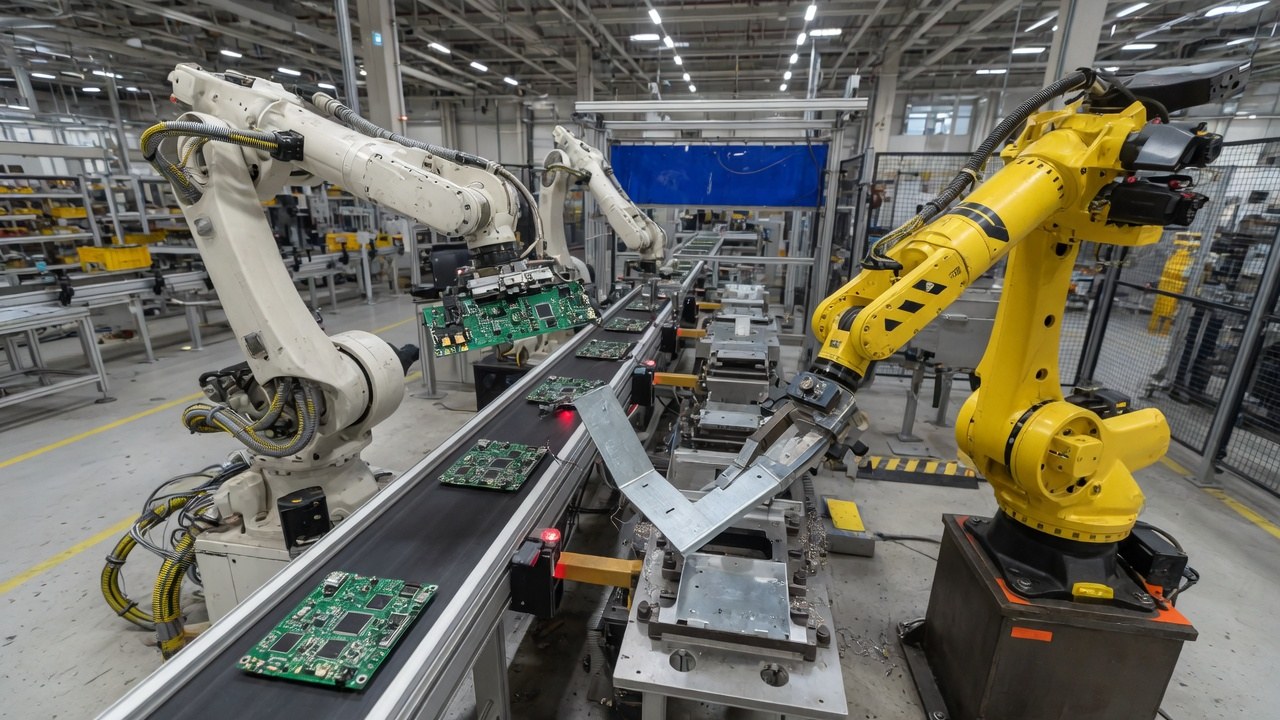
Industrial Robot Orders Surge Across North America as Automation Spreads Beyond Automotive
Summary
The Association for Advancing Automation (A3) reports steady growth in North American industrial robot sales, with adoption accelerating rapidly outside traditional automotive assembly lines. Major investments in domestic semiconductor manufacturing, life sciences, and electronics are expanding the footprints of robotic hardware and intelligent automation across factory floors.
Deep Dive: Expanding Beyond the Auto Industry
Historically, the auto industry served as the primary engine for industrial robotics. However, recent quarterly data shows non-automotive sectors accounting for more than 56% of total unit orders.
Key growth sectors driving this shift include:
- Semiconductors & Electronics/Photonics: Up 35% in unit orders, fueled by reshoring initiatives and new fabrication plant builds.
- Life Sciences, Pharma & Biomed: Up 32% in unit orders, driven by high-precision lab automation, cleanroom material handling, and automated sorting.
- Collaborative Robots (Cobots): Cobots accounted for over 15% of all robot units ordered in the first half of the year, with strong demand coming from labs and electronics facilities.
Key Takeaways for Industry Watchers
- Flexibility Over Rigidity: Legacy industrial robots required rigid, isolated work cells. Modern installations pair robotics with integrated computer vision and adaptive AI software, making them capable of handling item variation on the fly.
- Labor Re-allocation: Facility managers are deploying automated systems to handle repetitive, high-precision, or hazardous tasks, allowing skilled human workers to shift toward supervisory and technical roles.
- Lower Barrier to Entry: Simplified software interfaces and modular hardware setups mean small-to-medium enterprises (SMEs) can now achieve a positive return on investment (ROI) far faster than a decade ago.
How a shop should read the order surge
A sector is not a shopping list
The order numbers are a map of where robot arms are being bought. They are not a shopping list for your building. A semiconductor tool and a packing table can both show up as a robot order, and they share almost no parts. Read each sector as a kind of work, then ask which kind you actually have. Automotive lines were often built to repeat one body style for years. A shop packing electronics, filling a tray, or moving a bracket may change the part every month. That difference is why cameras and cobots show up with those new orders.
Vision, cobots, and your own limits
A camera lets one cell accept some change in shape without a new fixture for every shape. A cobot is an arm that can share a room with a person, which matters when you cannot give the machine its own walled cell. The share of orders outside auto work is a warning against copying a car plant. The useful examples for a smaller shop are a table, a fence or a sensor that stops the arm, a camera if the part moves, and a program a technician can reopen. A cobot's share of the market does not mean a cobot has the reach or the payload for your part. Add the weight of the part and the gripper, and the speed you need, and compare that with the arm's published limits, with margin left over.
One job, then the trend
More companies are buying robot arms for jobs other than building cars. The buyers who get value aim them at one repeated job, connect a camera when the part varies, and keep someone who can change the program when the order changes. The surge may be a real trend. Your cell still starts with your part, your table, and the seconds you have. Write those three down before you read another percentage. If the job is rare, heavy in a way the arm cannot hold, or different every cycle, an arm may be the wrong tool even while the national numbers climb.
Help setting up a robot cell: choose the hardware, lay out the cell in software, and membership support for $19.99 a month.